Sundown, December 4, 2025 to Sundown, December 5, 2025.
Hebrew Day 249 (500*0.498).
Our Mother Never Leaves Our Side.
Spiritual Note: 7379.613/29.637.
Spiritual Note: 249.326/22.666 = Nisan 11.
Lunar Calendar: 249.21/9.23 = Nisan 27.
Spiritual Note: Day 249 + 21 Days = Hebrew Day 270.
The Trinity: 249.084, 249.417, 249.75.
An AI Overview is not available for this searchCan’t generate an AI overview right now. Try again later.
AI Overview
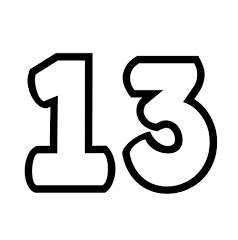
The number 13 is a prime number, which is the 6th prime number and can be represented by the Roman numeral XIII. It is often considered unlucky in Western culture, leading to superstitions like buildings skipping the 13th floor, though this is not a universal belief. Mathematically, it is a Fibonacci number and part of the Pythagorean triple (5, 12, 13).
Mathematical properties
- Prime: 13 is a prime number, meaning its only divisors are 1 and 13.
- Fibonacci: It is a prime number that appears in the Fibonacci sequence.
- Pythagorean Triple: It is the hypotenuse of a right triangle with the other two sides being 5 and 12, since
52+122=132 (
25+144=169).
- Numeral Systems:
- Binary:
11012
- Roman: XIII
- Hexadecimal: D₁₆
- Binary:
Cultural and superstitious associations
- Unlucky: In many Western cultures, 13 is considered an unlucky number, a fear known as triskaidekaphobia.
- Building floors: Some buildings skip the 13th floor, going directly from the 12th to the 14th.
- Tarot: The 13th card in many tarot decks is the Death card, which has contributed to its unlucky reputation.
- Lucky: Conversely, in some cultures, 13 is considered a lucky number.
The number 13 (thirteen) is the natural number that follows 12 and precedes 14. It holds various meanings across mathematics, culture, and religion, often associated with both extreme luck and misfortune.

In Mathematics
In mathematics, 13 has several specific properties:
- Prime Number: It is the sixth prime number, meaning it can only be evenly divided by 1 and itself.
- Fibonacci Number: It is part of the Fibonacci sequence (8 + 5 = 13).
- Happy Number: It is a happy number because the process of summing the squares of its digits eventually reaches 1 (1² + 3² = 10, and 1² + 0² = 1).
- Tridecagon: A regular polygon with 13 sides is called a tridecagon.
Hebrew Day 602 (25*24.08).
Hebrew Day 985 (500*1.97).
Hebrew Day 1338 (16056/12).
Full Moon (Blue Moon)

Spiritual Note: 249.984/13.888 = Twins @ The Trinity.
Hebrew Day 3899 (250*15.596).
Hebrew Day 6430 (250*25.72).
Hebrew Day 8991 (250*25.964).
Hebrew Day 11522 (250*46.088).
Comprehending The 6th Day of Creation: 221.28/36.88 = 6.
Spiritual Note: Day 221 + 28 Days = Kislev 13.
Matrix Day 5452
Matrix Day 43803.
AI Overview
The “Sith day of creation”
likely refers to the Sixth Day of Creation in the biblical Book of Genesis, when God created land animals, birds, and, as the crowning achievement, humanity (man and woman) in His image, establishing their dominion over the Earth before resting on the seventh day. In Jewish tradition, Rosh Hashanah (the Jewish New Year) commemorates this sixth day and the creation of man.
What happened on the Sixth Day (Genesis 1:24-31):
- Land Animals: God created all kinds of living creatures to roam the earth.
- Humans: God made man and woman in His own image, granting them personality, morality, spirituality, and dominion over all other creatures.
- Completion: God observed everything He had made and declared it “very good,” marking the end of the physical creation week before the Sabbath rest on the seventh day.
Significance in Jewish Tradition:
- Rosh Hashanah: This holiday celebrates the creation of humankind, the culmination of the six-day creation, emphasizing humanity’s unique relationship with God.
In contrast to other beliefs:
- Islamic Tradition: The Quran also mentions creation in six days, but describes it in stages: earth creation (2 days), preparation (4 days), and heavens (2 days), totaling six periods.
On the sixth day of creation, according to the Book of Genesis in the Bible, God created land animals and humans.
After creating various types of land-dwelling creatures, God made humankind in His own image, both male and female, as the apex of His creation. God blessed them and gave them dominion and authority over all other living creatures on the earth, as well as the mandate to be fruitful, multiply, and fill the earth.
Events of the Sixth Day (Genesis 1:24-31)
- Creation of Land Animals: God commanded the earth to bring forth various kinds of living creatures, including livestock, wild animals, and reptiles.
- Creation of Humanity: God said, “Let us make man in our image, after our likeness”. He created them as the final act of creation on this day, giving them a special status above all other life forms.
- The Dominion Mandate: Humans were instructed to steward the earth and have authority over all fish, birds, and other animals.
- Provision of Food: God provided every plant yielding seed and every tree with seed in its fruit as food for both humans and all animals.
- Declaration of “Very Good”: At the end of the sixth day, God observed everything He had made, including humanity, and declared His entire creation as “very good,” marking the completion of His creative work.
The seventh day followed, on which God rested from all His work, blessed the day, and made it holy, establishing the pattern for the Sabbath.
 watchinggod777